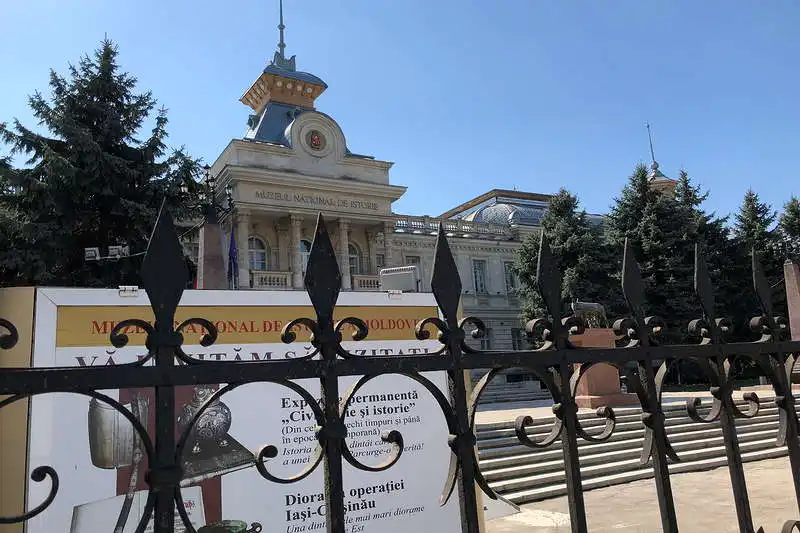
National Museum of History of Moldova, Chisinau, Republic of Moldova

History of Moldova Hour

Where, when, how much?

The National Museum of History of Moldova It is located right in the center of the capital city, Chisinau, on 31 August 1989 Street, one of the most important arteries of the city. The location is easily accessible on foot from the central area, as well as by public transport, being well connected to the urban network.

Visiting program:
The museum is generally open from Tuesday to Sunday, between 10:00 AM and 6:00 PM. It is closed on Mondays. The schedule may vary on holidays, so it is recommended to check before your visit.

Ticket prices:
The prices are affordable, making the museum a great stop for any travel budget:

  • Adults: approximately 10–20 Moldovan lei
  • Students and seniors: reduced fare
  • Young children can benefit from free entry

Additional fees may apply for guided tours or access to certain temporary exhibitions.

In conclusion, visiting the museum is not only a valuable cultural experience, but also a budget-friendly one, perfect to include in a one-day itinerary through Chisinau.

About the National Museum of History of Moldova

The National Museum of History of Moldova This is one of the most important cultural institutions in Chisinau and a landmark for understanding the complex history of the land between the Prut and Dniester rivers. Founded in 1983, the museum houses an impressive collection of artifacts spanning thousands of years of history – from prehistoric times to the contemporary period. Visitors can explore thematic exhibitions illustrating the evolution of civilizations in this region, including the Geto-Dacian culture, the Roman period, the Middle Ages, and modern transformations. Among the most valuable pieces are archaeological treasures, medieval weapons, historical documents, and decorative art objects, each telling a part of the story of Moldovan identity.

One of the museum's symbols is the monumental replica of the Capitoline Wolf, placed in front of the building – a reference to the people's Latin origins. The institution is also recognized for its spectacular diorama dedicated to the Battle of Tighina, which offers a visual perspective on an important moment in recent history. In addition to permanent exhibitions, the museum frequently organizes temporary exhibitions, cultural events, and educational programs, serving as a dynamic space dedicated to both research and the popularization of history. A visit here is not just about walking through exhibition halls, but a captivating journey into the past of a region at the crossroads of great cultures and empires.

1. Prehistory – Ancient History

One of the most captivating sections of the National Museum of History of Moldova takes you on a fascinating journey through the origins and early evolution of civilization in the territory of present-day Moldova.

The prehistoric exhibition reveals traces of the first human communities that inhabited these lands, with artifacts dating from the Paleolithic and Neolithic periods: stone tools, decorated pottery, and everyday objects. Important cultures are illustrated, such as the Cucuteni-Trypillia culture, recognized for its spectacular pottery and advanced level of social organization.

The transition to ancient history is marked by vestiges of the Getae-Dacian populations, considered the direct ancestors of the region's inhabitants. Visitors can admire weapons, jewelry, and ritual objects, as well as evidence of commercial and cultural contacts with the Greek and Roman world. The influence of the Roman Empire is reflected through coins, inscriptions, and other discoveries that suggest intense economic and cultural ties.

This section offers a clear perspective on Moldova's historical roots, being essential for understanding the region's cultural and identity evolution over the millennia.

ceramic objects

History hour in Chisinau

prehistory - ancient history - middle ages

13th-18th Centuries

The section dedicated to the 13th–18th centuries at the National Museum of History of Moldova captures the period of formation, consolidation, and affirmation of the Principality of Moldavia, offering a detailed insight into an era marked by confrontations, alliances, and significant cultural developments.

Visitors discover the beginnings of state organization in the 14th century, when Moldova became a relevant political player in Eastern Europe, situated between the influences of great regional powers such as the Kingdom of Hungary, the Kingdom of Poland, and the Ottoman Empire. The exhibitions highlight the complex diplomacy and defense strategies adopted by Moldavian rulers.

A central place is occupied by the reign of Ștefan cel Mare (1457–1504), one of the most representative figures of medieval history. Weapons, armor, documents, and reconstructions of important battles, such as the Battle of Vaslui, considered one of the greatest victories against Ottoman expansion in Europe, are presented.

Besides military and political aspects, the exhibition also emphasizes daily life and cultural development. Religious objects, manuscripts, icons, and elements of religious architecture illustrate the essential role of the church in society. At the same time, Byzantine and Eastern artistic influences are presented, which contributed to shaping the region's cultural identity.

The period of the 17th-18th centuries reflects the changes brought about by Ottoman rule and the Phanariot regime, highlighting administrative, economic, and social transformations. Through documents, costumes, and period objects, visitors can better understand how Moldavia adapted to these external influences.

This section offers a complex view of a crossroads era, in which the foundations of Moldova's historical and cultural identity were laid.

13th-18th centuries

Stephen the Great

3. The Years 1812-1900

The period 1812–1900, presented within the National Museum of History of Moldova, marks a stage of profound political, social, and cultural transformations for the territory between the Prut and Dniester rivers. It all begins with the Treaty of Bucharest (1812), as a result of which the eastern part of the Principality of Moldova, later known as Bessarabia, is annexed by the Russian Empire.

The exhibition illustrates the impact of the Tsarist administration on the region: administrative reorganization, demographic changes, and Russification policies that influenced local identity. Official documents, historical maps, and period artifacts provide a detailed picture of how imperial authorities integrated this territory.

At the same time, visitors can discover the evolution of urban and rural life in the 19th century. Cities like Chisinau began to develop rapidly, becoming important administrative and cultural centers. Objects related to daily life are exhibited – traditional costumes, tools, furniture – as well as elements that reflect the modernization of society, such as the emergence of educational institutions and printing.

Another important aspect of the exhibition is the reawakening of national consciousness in the second half of the 19th century. Through publications, correspondence, and portraits of cultural figures, the beginning of the affirmation of Romanian identity in Bessarabia is illustrated, despite the political and cultural pressures of the empire.

This section offers a balanced perspective on a transitional period, where tradition and modernity coexist, and regional identity begins to redefine itself within a complex geopolitical context.

1812-1900

through the museum

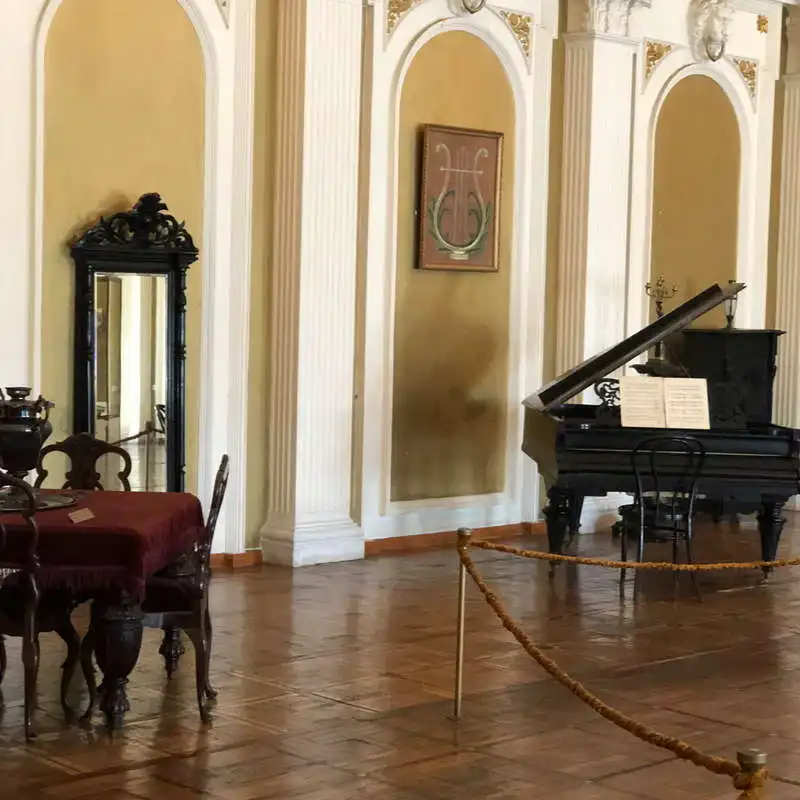
Interior decorations

1900-1940

The section dedicated to the years 1900–1940 in the National Museum of History of Moldova captures a period of political and national effervescence, marked by decisive events for the destiny of Bessarabia. At the beginning of the 20th century, the region was still under the administration of the Russian Empire, but social and political tensions were on the rise.

A turning point is represented by the Russian Revolution of 1917, which led to the collapse of Tsarist authority and the affirmation of national movements. In this context, the Sfatul Țării (Country Council) was created, a representative body that would play an essential role in making major political decisions.

The centerpiece of the exhibition is the Union of Bessarabia with Romania, voted for on March 27, 1918 – a defining moment for the region's identity. Visitors can see original documents, period photographs, and artifacts that reflect the atmosphere of those years, as well as portraits of personalities involved in this historical process.

The interwar period (1918-1940) is illustrated by a variety of exhibits highlighting Bessarabia's integration into Romania. Administrative reforms, the development of education and culture, as well as the modernization of cities, particularly Chișinău, which acquired a European flair, are presented.

The end of this stage is marked by the Soviet Ultimatum of 1940, following which Bessarabia is occupied by the Soviet Union. This abrupt change of regime brings dramatic transformations, reflected in the documents and testimonies on display.

Through this section, the museum offers a clear picture of a dynamic period, in which national ideals, political changes, and external influences profoundly shaped the region's evolution.

1900-1940

video camera

Act of the Union of Bessarabia

5. The 1940s-1950s

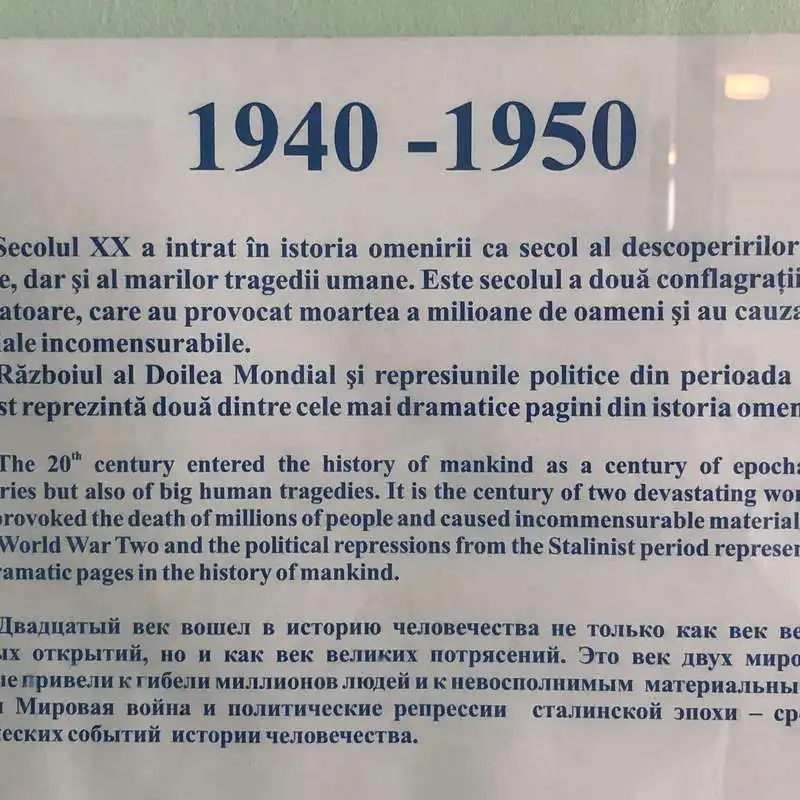
The period 1940-1950, illustrated in the exhibitions of the National Museum of History of Moldova, is one of the most dramatic and significant stages in the region's history. The events are dominated by the consequences of the 1940 Soviet Ultimatum, following which Bessarabia was occupied by the Soviet Union and integrated into its structure.

The exhibition captures the rapid and profound changes imposed by the new regime: nationalization of property, restructuring of society, and the beginning of political repression. Documents, photographs, and personal items reflect the impact of these transformations on the local population.

An important chapter is dedicated to mass deportations, particularly those during the Soviet deportations from Bessarabia, when tens of thousands of people were sent to Siberia and other remote regions. The testimonies and exhibits displayed offer a moving perspective on the suffering endured by those affected.

The period of World War II is also well represented. In 1941, Bessarabia was reconquered by Romania, allied with Nazi Germany, but in 1944 the territory returned to Soviet control. These successive changes in administration are illustrated by military uniforms, weapons, maps, and frontline documents.

The post-war years brought famine, reconstruction, and the consolidation of the Soviet regime. The exhibition highlights the economic difficulties, but also the accelerated process of Sovietization, which profoundly influenced the social and cultural structure of the region.

This section offers a powerful and often disturbing perspective on a decade marked by conflict, suffering, and radical transformations, essential for understanding the recent history of the Republic of Moldova.

1940-1950

headphones and weapons

History hour in Chisinau

20th Century

The section dedicated to the 20th century at the National Museum of History of Moldova offers a comprehensive overview of the major transformations that shaped the destiny of the region in the modern era. It is a complex period, marked by frequent political changes, conflicts, and the redefinition of national identity.

After the dramatic events of the first half of the century, Bessarabia became part of the Soviet Union for several decades, where it became the Moldavian Soviet Socialist Republic. The exhibitions present the process of sovietization: collectivization of agriculture, forced industrialization, and social transformations imposed by the communist regime. Objects from daily life, political propaganda, photographs, and documents illustrating the reality of those times are exhibited.

An important space is dedicated to the period of national rebirth in the 80s, when, against the backdrop of reforms initiated in the USSR, movements for the affirmation of cultural and linguistic identity began to emerge. These developments eventually led to the proclamation of the Independence of the Republic of Moldova, a defining moment reflected through official documents and archival images.

Also, the museum addresses the Transnistrian conflict, illustrated by exhibits and testimonies related to the Transnistrian War, highlighting the challenges faced by the new independent state.

Through this section, visitors can better understand the complexity of the 20th century in this part of Europe – a period in which ideologies, borders, and society changed radically, leaving visible traces to this day.

20th century

Gospel

Diorama "Operation Iași-Chișinău. 1944"

watch collection

Directional signs

The Gulag Archipelago

Soviet Moldova

Conclusion

The National Museum of History of Moldova It is one of the most important cultural landmarks in Chisinau and an essential stop for anyone who wants to understand the history of the Republic of Moldova. If you come to the city, it is definitely worth including it in your itinerary.

All the best!


Steps:

en_USEnglish