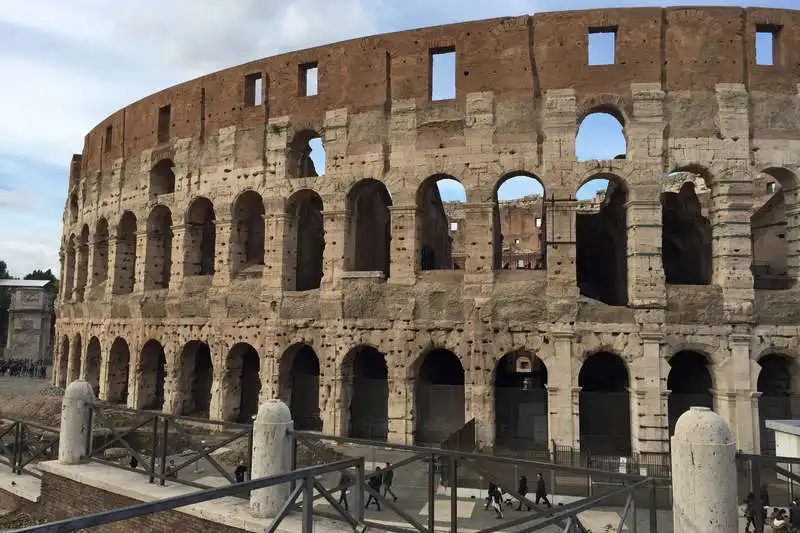
Colosseum, Rome, Italy

Palatine Hill, Roman Forum, Colosseum and Trajan's Column

Where, when, how much?

📍 Where is the Colosseum?

Colosseum (also known as Flavian Amphitheater) is in the heart of Rome, in Piazza del Colosseo, at Piazza del Colosseo, 1, 00184 Rome, Italy. You can get there easily by public transportation:

  • Metro: Line B - station Colosseum is right opposite the monument.

  • Buses: 75, 81, 175, 204, 673 and others stop nearby.

  • Tram: Line 3 drops you near the entrance.


🕐 When can you visit?

The Colosseum is open to visitors almost every day of the year, except December 25 (Christmas) and at special times when it may be closed for holidays or works.
The typical program varies depending on the season:

  • Winter/early spring: 08:30 - 16:30

  • Spring: 08:30 - 17:30

  • Summer (approximately): 08:30 - 19:15

  • Early fall: 08:30 - 19:00

The last entry is usually about an hour before closing time.

👉 Tips:

  • Booking your ticket is recommended at least 30 days in advance, especially in the busy summer season.

  • For a pleasant and less crowded experience, visit it early morning or to evening.


💶 How much does the visit cost?

Ticket prices may vary depending on the type of access and season, but these are indicative for standard visits (official dates from 2025-2026):

🎟️ Basic tickets

  • Adult (standard): ~€18 - access to Colosseum (basic levels) + Roman Forum + Palatine Hill.

  • Discounts: ~€2-€4 for EU 18-25 year-olds.

  • Free: children under 18 and disabled persons + one accompanying person.

🎟️ Full Experience / extended access

  • Around €24 - includes access to:

    • higher levels

    • arena and underground areas (where available)

    • Palace and Imperial Forums.

🎟️ Special experiences

  • Night tour: ~€50 (visit after dark).

  • Guided tours: ~€40-€90 (with licensed guide).

📌 Standard tickets usually include access to the Roman Forum and Palatine Hill, valid for 24 hours from first entry.

👉 Note: prices may increase if you buy tickets from third party agencies or tourist packages (e.g. skip-the-line or combined with other attractions).


🧠 Tips for planning

✔️ Book online before departure: The Colosseum is one of the most visited attractions in the world and tickets can sell out quickly.
✔️ Come in sooner or later: peak hours are between 10:00 and 16:00.
✔️ Check for free entry on Sundays: Every first Sunday of the month, admission is free, but the crowds are much bigger.

About Colosseum

The Colosseum is emblem of ancient Rome and one of the most impressive monuments in the world. Built in the 1st century AD, during the Flavian dynasty, this huge amphitheater was designed as a space for public performances and entertainment for the Roman people.

With a capacity of up to 75,000 spectators, The Colosseum has hosted gladiatorial fights, wild animal shows and dramatic re-enactments of great battles. Its ingenious architecture and impressive size make it a true masterpiece of Roman engineering.

Today, the Colosseum remains a symbol of Rome's power, history and grandeur, attracting millions of visitors who come to discover the fascinating stories hidden within its millennia-old walls.

1. Palatine Hill

We're looking from above, from the main street level Colosseum Square, a circular street surrounding the Colosseum. We don't stop at the long queue in front of our eyes, on Via Celio Vibenna with the entrance in front of the Arch of Constantine (Arco di Constantino), but we go down Via di San Gregorio, where two other queues are stretching out, one a bit longer, but shorter than the one mentioned above, for those who came on their own, individually, and one for groups accompanied by guides, a very small queue, about 10 minutes long. Here, after passing an arched entrance and the „customs” control, we paid tickets to the Colosseum, which we will visit much later.

We will stroll along alleys that already introduce us to old walls and admire Arch of Constantine from above. Four Dacians are permanently present on the arch of the monument, you can recognize them by their helmets. From the level of our road Arch of Titus, about the two I will mention later.

We get to a point where the question is asked: do you want to get on Palatine Hill ? The ascent is not difficult, it is done by stairs and takes about 10 minutes to the belvedere point, a terrace that offers a wide view over the Roman Forum and Colosseum, which we will visit a little later.

In the area Palatine Hill the following sights can be identified:

Domus Flavia the official wing of Domitian's imperial palace erected in 81, the monument can be recognized by the ruins of two fountains.

Livia House is a building, now under the earth, built in the 1st century BC and part of the residence of Emperor Augustus and his second wife.

Palatine Museum and Antiquarium is an exhibition of artifacts featuring ceramics, statues and mosaics.

Romulus' borders from the Iron Age. This is the village founded by Romulus, the founder of Rome, after he killed his brother Remus, according to legend.

Stadium, a rectangular building, Domitian's residence in the 1st century, today below ground level, with a huge garden and several racetracks.

Other sights are: Domus Augustana, Temple of the Goddess Cybele, Farnese Garden, Cryptoporticus, Dome of Septimius Severus.

Arch of Titus

Entry with the shortest queue

Roman Forum

Roman Forum from Palatine Hill

2. Roman Forum

We descend from Palatine Hill to ground level, down into the frozen world in time of Roman Forum. In the following I will tell you about a symbol of Rome, a symbol of civic pride for over a millennium.

In the beginning, 2770 years back in the book of time, on this site there was a marshy area where the Palatine Hill village cemetery was located. The swamp had dried up. Rome grew and became powerful. In the 6th century BC, the Forum played a central role in the life of the Republic. But it gained its prominence during the reign

the first Roman emperor, Augustus. Augustus completely changed the face of the city, transforming it from brick to marble.

By the way, ladies and gentlemen of AFA Augustus: Have you visited these places?

Roman Forum is situated in the valley surrounded by the Palatine and Capitoline Hills. It was the political, economic, religious and commercial center of Ancient Rome in the 5th - 1st centuries BC, where the villages that had sprung up in the area were united by expansion over time. The Mollas here were known by the name, suggestive for us, of Maxima sewer. The work to clean up the swamps in the valley involved draining the water towards Tiber River, which flows nearby.

With the development of the area, more and more streets and buildings such as churches, domes, public buildings, temples, and buildings that housed public functions appeared. Roman Forum has hosted political competitions or meetings.

The most important objectives in the area Roman Forum are:

Arch of Septimius Severus

It is a triumphal arch erected in 203 B.C. by Geta and Caracalia, sons of the emperor Septimius Severus to celebrate their father's victories in the Middle East. The monument is well preserved and has three arches.

Temple of the goddess Vesta and the House of the Vestals

It has a round shape. It and the palace next to it were the center of a much revered cult of Rome. Its priestesses were noble and had many privileges.

Curia

East Curia Senate of Rome. It was built in the 3rd century. It preserves the original floor with polychrome inlays and the kneeling couches where the 300 voting senators sat, as well as the platform where speeches were made.

Temple of Castor and Pollux

This temple is partially destroyed, today three columns of the original construction can still be admired. It is dedicated to the Dioscuri, the twin brothers of Helen of Troy and sons of Jupiter and Lyeda. The shrine marks the spot where they miraculously appeared in 499 BC to announce an important victory for Rome.

Arch of Titus

Arch of Titus was built in 81 by Emperor Domitian, in honor of his brother Titus and his father Vespasian, after they put down the Jewish revolt. It's a single-span arch. The frescoes show images of the sacking of Jerusalem by Roman soldiers, I've attached the picture.

Recommendations

Access to the Romanian Forum can be done from four directions:

-on Via dei Fiori Imperiali, at the end of the Capitoline, behind the huge, magnificent monument to Victor Emmanuel,

-on Via dei Fiori Imperiali, from the Colosseum (where we will exit)

-from Palatine Hill (where we entered)

-from the Arch of Titus, near the main entrance to the Palatine Hill.

On very hot days, cover your head, the area is an open one, exposed to the sun's rays. Or come here early in the morning or in the cool evenings. Visiting the Roman Forum is free.

Other attractions of the Roman Forum are Church of Maxentius and Constantine, Temple of Vespasian, Via Sacra, Temple of Saturn, Temple of Antonius and Faustina.

The Roman Forum is impressive

basoreliefuri

The bas-reliefs of the Arch of Titus

Arch of Titus

Temple of Antonino and Faustina

Temple of Giulio

Arch of Constantine

ancient inscribed stone

3. The Colosseum

Heading from the Roman Forum to the Colosseum presents no danger of getting lost. You simply head towards the grandiose construction (now on an organized walkway due to excavations in the area) and get in line.

Go to

The visiting program is unique: The Colosseum opens in the morning at 8:30 am and closes one hour before sunset, a time that varies depending on the month of the year you wish to visit. In our case for the month of December, the time to consider is 15:30. We wondered how that comes? What, at 4:30 it's dark? We didn't think so, but in December, in Rome, it's intuenca at half past four!

Ticket

There are many prices and packages to visit the different sights of Rome. For 2 or 3 days or individual, with or without transportation included, with or without a guide, which can be audio or personal. We paid 8 Eur per person, strictly for visiting the Colloseum.

Colosseum area

The Colosseum, by extension, is a huge archaeological area, which includes the most representative vestiges of the ancient world in these lands. The controversial Mussolini, almost to the present day, took the decision to “disturb” this area with various infrastructure works, which was not at all to the Romans' liking.

Colosseum area should be seen as an area that includes the Colosseum itself and the Arch of Constantine, as well as the surrounding imperial forums of Trajan, Nerva, Caesar and Augustus, and the Domus Auraea.

The Colosseum is the symbol of Rome and the Romans. They identify with this monument. Any attack on the Colosseum is an affront to the Romans. Rome has endless sights, but the Colosseum is the Colosseum.

The grandiose Colosseum was built between 72 and 80, during the reign of the Flavian emperors and was originally named Flaviilors Amphitheater. Jewish slaves, brought to Rome after the defeat of their revolt, were used to build the edifice. It was called the Colosseum after the fall of the Roman Empire.

According to wiki: “Unlike the amphitheaters previously built between two hills, the Colosseum is a free-standing structure, entirely built. Its plan is elliptical, 189 m long and 156 m wide, with an area of 6 ha. The exterior wall is 48 m high. The original perimeter measures 545 m. The central arena is oval, 86 m long and 156 m wide, surrounded by a wall 4.5 m high, rising to the level of the first rows for spectators. ”

The Colosseum is a huge arena, for those times, a stadium, which could hold over 50,000 people in the stands. Cruel spectacles involving the sacrifice of human and animal life took place here, to the delirious cheers of the spectators. The famous gladiatorial battles are well known. Prisoners of war were made to fight each other or wild beasts.

This type of construction with stands in an amphitheater surrounding the “field of play” has remained the basis of stadium design to this day.

Emperor Titus dedicated the opening of the Colosseum's amphitheater to 100 days of celebratory games in which 5,000 wild animals were killed. This kind of spectacle, very popular at the time but hard to understand today, was meant to give the plebs

circus and bread. Thus the people were occupied and satisfied with these macabre representations, and at the end of the fights there were leashes of animals, some domestic, for example birds, with which the spectators could go back home. Not all fights had wild animals in the program. They were only brought in at certain “more festive”, more important moments.

We caught a bit of a line at the entrance, but it moved quickly. They check not only the ticket, but also bags, backpacks, etc, like at the airport. I've been to many stadium games. On older or modern stadiums. Only in Romania. When I walked up the steps of the Colosseum and exited through a gate at a first level of the stadium I had the same overwhelming image as when I first stepped on the new National Arena in Bucharest, the former and bigger August 23 once upon a time.

You visit several levels of the Roman arena. The access steps on the three levels are quite steep. Visitors can choose their favorite angles for filming or photography. The details of the construction, both of the amphitheater and the access galleries from the cages to the stage, or the emperor's sector, and the way two millennia have been preserved are remarkable. It is difficult to describe the Colosseum without being struck by the grandeur of this exceptional engineering achievement, if I may call it that. The Colosseum is a testament to Roman building skills.

Traian Square

Traian Square is another important landmark of ancient Rome. It is actually a commercial center built by the famous Apolodorus of Damascus in the 2nd century on the orders of Emperor Trajan. It was the most modern commercial center of its time and contained 150 rooms plus a top floor of offices. Today it would certainly be called a shopping mall.

Arch of Constantine

Arch of Constantine has three arches and is one of the must-see sights if you get to the Colosseum. It marks the victory Emperor Constantine the Great, the first Christian emperor, against the Emperor Maxentius. At the top of the arch are bas-reliefs of four Dacians. It's the largest surviving triumphal arch in Rome. It was erected in 315.

Domus Auraea

It is the Latin name for The Golden House of Nero. This can be visited for an additional fee of 6 eur; we did not do it.

Madness and eccentricities Emperor Nero have been collected as evidence here in this palace. It is the most extravagant and richest Roman palace of all time. The purpose of this house was for amusement. At its height, the estate covered over an acre and included a forest.

The style of the murals in the palace is known today as the “grotesque” style, because when they were discovered in the 14th century it was thought that mysterious grottoes had been discovered. The style later influenced Renaissance artists.

Dacians on the Arch of Constantine

Colosseum model

Colosseum

Details from the Colosseum arena

Colosseum - MMXVII

Statue of Nerva

Ne luam arivederci de la Colosseum

Statue of Augustus

4. Trajan's Column

From the Colosseum we follow Via dei Fori Imperiali to head towards Trajan's Column, monument which is an integral part of Traian's Forum. We got here passing by statues of Trajan, Nerva and Augustus.

Trajan's Column is remarkable for the graphic details present on its exterior which have been preserved in excellent condition. There are scenes from the Roman battles against the Dacians fought by Emperor Trajan.

We also remember with pleasure the true story of our Adrelean Badea Cartan. Badea Cartan was a simple Roman, a shepherd, who was interested in the history of the Roman people. To this end, he set out to see for himself the evidence of the history of the Roman people in Rome by setting out on foot. When he got tired, he sat down at the base of Trajan's Column. The next day he became famous when the Italian press wrote “a Dacian came down from the Column: with a mop of hair, with shirt and shirt shirt, with yokes and with hat.”.

details from Trajan's Column

Statue of Caesar

Trajan's Column - the top

Trajan's Column

Conclusion

The Colosseum not visited, it feels. It's where history comes alive and Rome speaks to you across the centuries. If you get here, stop, look and be swept away by the majesty of a symbol that has stood the test of time. The Colosseum awaits you.

All the best!

Steps:

en_USEnglish