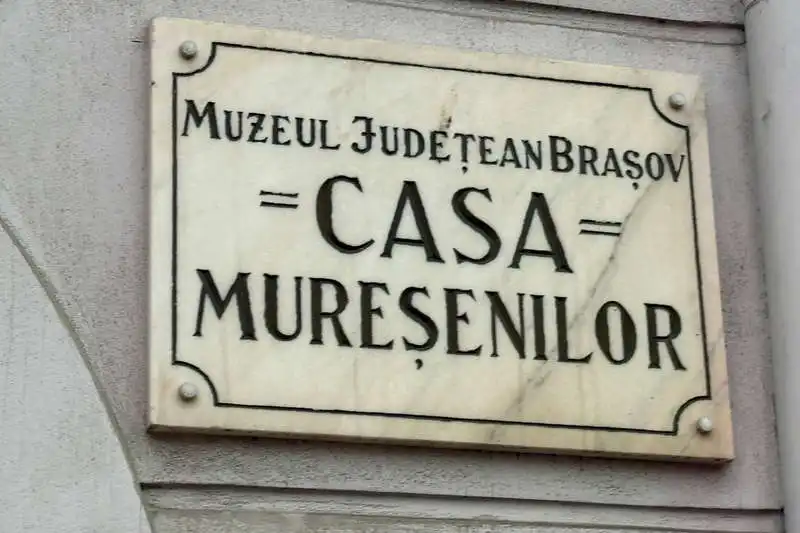
Muresenilor House, Brasov, Brasov

Muresianu family secrets

Where, when, how much?

House of the Moures is located right in the heart of the historic center of Brasov, on 25 Sfatului Square.

The museum is open to the public according to the following program:

  • Tuesday - Saturday: 09:00 - 17:00

  • Monday: 11:00 - 17:00

  • Sunday: closed.

Museum admission fees are accessible and designed for all ages:

  • Adults: ~8 RON

  • Pensioners: ~4 RON

  • Pupils, students, pre-schoolers: ~2 RON

📍 The ticket can be paid both in cash and by card, directly at the entrance. If you're planning to visit more museums in Brasov, there are also single ticket valid for several museums in the county

About the House of Moures

Casa Mureșenilor is one of the most important cultural landmarks of Brasov and a place where history, music and the Romanian spirit come together in an authentic story. The building, built in the 18th century, was the home of the Mureșianu (Mureșenilor) family - a family of intellectuals who played a key role in the cultural and political life of Transylvania.

Here were born or worked such outstanding personalities as Andrei Muresanu, the author of the lyrics of Romania's national anthem, as well as other family members involved in the press, music and cultural movements of the time. The house quickly became a true center of progressive ideas, a meeting place for people of culture and pașoptists revolutionaries.

Today, the House of the Moures functions as memorial museum, offering visitors a fascinating insight into the history of Brasov and modern Romania. The permanent exhibitions include original documents, manuscripts, musical scores, personal objects, period furniture and musical instruments, all carefully displayed in an elegant and intimate setting.

Besides its museum role, the House of the Moures is also a living cultural space, where classical music concerts, recitals, book launches and temporary exhibitions are frequently held. Its warm and refined atmosphere makes it an ideal place for those who want to discover Brasov beyond its famous attractions.

A visit to the Muresenilor House is not just a history lesson, but an experience that connects you directly with the cultural spirit of the city and the values that have contributed to the Romanian identity.

A movie about House of the Moures you can watch it here.

1. Jacob Muresianu

Iacob Muresianu was one of the central figures of Romanian cultural and journalistic life in Transylvania, known especially as founder of „Gazetei Transilvaniei”, the first Romanian political newspaper in the region. Its work had a major impact on the Romanian national consciousness in the 19th century.

Coming from a family of intellectuals from Brasov, Iacob Mureșianu transformed the Mureșenilor House into a true nucleus of the progressive ideas of the time. In 1838, he laid the foundations Transylvanian Gazette, which quickly became an essential platform for debating the political, social and cultural problems of Romanians in the Habsburg Empire.

Through its published articles, the gazeta supported Romanians' rights, the promotion of the Romanian language and access to education, playing an essential role in the preparation of the events of the 1848 Revolution. At that time, the Mureșenilor House was not only the family home, but also editorial, printing and meeting space for Romanian intellectual elites.

Today, at the House of the Moures, visitors can discover documents, old editions of the Transylvanian Gazette and objects illustrating Iacob Mureșianu's journalistic activity. His story provides a clear perspective on the role of the press in the formation of national identity and the importance of Brasov as a Romanian cultural center.

House of Jacob Muresianu

Iacob and Sevastia Mureșianu

bust of Iacob Muresianu

Iacob Muresianu

2. Andrei Muresanu

Andrei Muresanu is one of the most emblematic personalities of Romanian culture and history, best known as the author of the poem „A resonance”, which later became National Anthem of Romania - „Wake up, Romanian!”. His life and work are closely linked to Brasov and the Casa Muresenilor, a place that was a true space of revolutionary ideas and the affirmation of national identity.

Poet, publicist and active participant in the 1848 Revolution, Andrei Muresanu was a strong voice for Romanians in Transylvania in a period marked by the struggle for rights, freedom and national unity. Through his articles published in Transylvania Gazette, he supported the political and cultural emancipation of Romanians, promoting the values of Romanian language and culture.

The poem „A resonance”, written in the effervescent context of the revolutionary year of 1848, quickly became a symbol of resistance and national solidarity. Its lyrics, full of strength and emotion, have spanned generations, being sung at key moments in Romania's history and officially enshrined as the national anthem after 1989.

The House of the Moures, the legacy of Andrei Muresanu is presented through original documents, period editions, manuscripts and references to his publishing and literary work. Visitors can discover not only the author of the national anthem, but also a man actively involved in the life of the city, deeply connected to the ideals of his time.

For those who visit Brasov, Andrei Muresanu's story adds a special emotional dimension to the experience at the Casa Muresenilor, transforming the museum into a place of memory, identity and values that define the Romanian spirit.

Andrei Muresianu and the 1848 Revolution

Aurel Muresianu and "Wake up, Romanian!"

Andrei Muresianu

3. Aurel Muresianu

Aurel Muresianu was one of the outstanding personalities of the Mureșenilor family, continuing the journalistic and cultural tradition started in Brasov in the 19th century. A publicist, lawyer and politician, he played an important role in the public life of Romanians in Transylvania, being an active voice in the struggle for national rights and cultural affirmation.

The son of Iacob Muresianu, Aurel Muresianu was closely linked to the activity Transylvanian Gazette, one of the most influential Romanian publications of the time. Through his articles, he supported the cause of Romanians, promoting the values of the Romanian language, education and national solidarity in an often difficult political context.

Besides his publishing activity, Aurel Mureșianu was actively involved in political life, as a member of the Parliament in Budapest, where he represented the interests of Romanians in Transylvania. His speeches and positions reflected his constant commitment to the civil and cultural rights of the Romanian community.

The House of the Moures, Aurel Muresianu's contribution is evoked through documents, articles and testimonies of his public activity. Visitors can thus understand the continuity of a family which, generation after generation, has transformed this house into a true center of the press, ideas and the struggle for national identity.

The story of Aurel Muresianu completes the historical picture of the House of Mures, highlighting the essential role of the family in the formation and consolidation of Romanian national consciousness.

Aurel Muresianu

Aurel Mureșianu and Gazeta Transilvania

4. George Dima

George Dima was one of the most important personalities of Romanian music at the end of the 19th and beginning of the 20th century, composer, conductor and pedagogue who contributed decisively to the development of musical life in Transylvania. His name is closely linked to Brasov and the Casa Mureșenilor, a place where the family's musical tradition blended harmoniously with the affirmation of Romanian cultic music.

Trained in the spirit of European classical music, George Dima was a fervent supporter of the valorization of Romanian folkloric elements in the creation of cultured music. His choral and vocal works have played an essential role in popularizing the Romanian language through music and in strengthening the national cultural identity.

In Brasov, George Dima was actively involved in the artistic life of the city, collaborating with Romanian Music Meeting, an institution closely linked to the cultural activity carried out at the Casa Mureșenilor. The concerts, recitals and musical evenings organized here transformed the house into a living art space, where music became a means of education and national expression.

Today, the legacy of George Dima is evoked at the Casa Mureșenilor through documents, scores and the continuity of the musical events hosted in this space. For visitors, his story adds a sonic and emotional dimension to the museum experience, highlighting Brasov's role as an important cultural center of Transylvania.

George Dima and music

George Dima

5. The evolution of music

Music has played a key role in the history of the Muresenilor House, transforming it from a simple family home into a veritable family home center of Brasov's musical life. Throughout the 19th and 20th centuries, the house witnessed a continuous evolution of musical expression, reflecting the cultural and social changes of the time.

In the second half of the 19th century, choral and vocal music became an important tool for asserting national identity. Members of the Muresenilor family, along with personalities such as Iacob Muresianu, George Dima and other musicians of the era, supported the development of a Romanian repertoire, inspired by folklore and adapted to the rigors of European cultured music.

The House of the Mureșenilor frequently hosted rehearsals, auditions and musical evenings, becoming a meeting place for artists, intellectuals and music lovers. Here, music was not only a form of entertainment, but also a means of cultural education and community building.

In the 20th century, the musical tradition was carried forward by the constant organization of classical music concerts, chamber recitals and themed events, adapted to new generations of audiences. This continuity has transformed the Casa Mureșenilor into a recognized cultural landmark, where past and present music meet harmoniously.

Today, the evolution of music at Casa Mureșenilor can be discovered both through the museum exhibitions and the cultural events organized in this space. For visitors, the experience offers a complete perspective on the role that music has played in the cultural life of Brasov and in the affirmation of Romanian identity.

Mures women

the evolution of music

gramofon

musical instruments

6. Temporary exhibition Ștefan Baciu

Temporary exhibition dedicated to Stefan Baciu brings to the foreground one of the most fascinating personalities of Romanian culture in the 20th century, poet, essayist, journalist and diplomat, with a career that spanned Europe and Latin America. Hosted by Casa Mureșenilor, the exhibition naturally completes the story of this space as a place of ideas, creation and cultural dialog.

Born in Brașov, Ștefan Baciu was a cosmopolitan spirit, deeply attached to his native city, but open to the major international literary trends. The exhibition presents original documents, manuscripts, correspondence, photographs and rare editions illustrating his intellectual journey, from his literary beginnings in Romania to his work in exile.

A special emphasis is placed on Ștefan Baciu's relationship with avant-garde literature and the South American cultural milieu, where he constantly promoted Romanian poetry and created bridges between cultures. Visitors can discover a non-conformist creator, concerned with freedom of expression and dialog between different cultural identities.

Integrated in the context of the Casa Mureșenilor, the temporary exhibition Ștefan Baciu offers a complete cultural experience, combining local history with an international perspective. For tourists and literary enthusiasts, it is an opportunity to discover a lesser-known side of cultural Brasov and to understand the city's role in shaping personalities with a global impact.

about Stefan Baciu

piano

portrait of Ștefan Baciu

paintings

temporary exhibition

Conclusion

House of the Moures in Brasov invites you to discover Romanian history, culture and music through exhibitions and memorable stories.

All the best!

Steps:

en_USEnglish